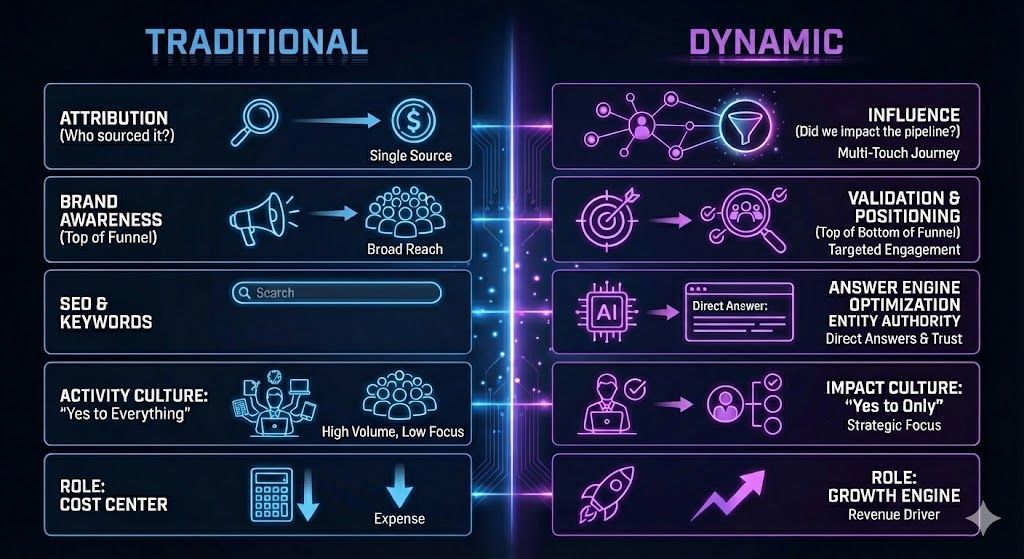
The Scale Up Gap Why Founder Led Growth Breaks
You built this company on instinct. You closed the first 50 customers yourself. You wrote the website copy at 11 PM, hired the agency that “kind of worked,” and approved every campaign because nobody else seemed to have the judgment.
It worked. You hit $5M ARR. Maybe $8M ARR .
And now the engine is sputtering. CAC is climbing. Your last hire is producing activity but not pipeline. You’re spending more on tools than ever, and you couldn’t tell a board member which tactic drove revenue last quarter.
This is the scale up gap and the place where founder led growth and marketing break.
The Hard Truth About Founder Led Growth
Founder led growth is a feature until roughly $5M in ARR, then it becomes the bug. The same conviction that got you here is now the bottleneck.
Here’s what’s actually happening inside your company: you have random acts of marketing. A webinar here. A LinkedIn push there. An SEO project that someone started in Q2 and quietly abandoned. There’s no connective tissue between your business goals and what marketing actually does on Tuesday morning.
A full time CMO at this stage is a $300K+ commitment with a 17-month average tenure. Which feels and is expensive at this stage. But staying founder led means you remain the strategic single point of failure and in the zone between $5M - $10M ARR, that’s reckless.
The Fractional CMO (fCMO) emerged precisely for this scale up gap. Not as a consultant who writes a deck and disappears. As a part time strategic architect who installs the operating system your company needs, then leaves it running or helps you scope the role for the next marketing leadership hire or transitions at the right time to be the full time leader.
Strategic Vision: Provide a founder’s off ramp
The first job of an fCMO is to translate your business strategy into a marketing system that doesn’t require your daily input.
That means a defensible positioning document. A clear ICP (ideal client profile) not the vague “mid-market companies” you wrote in 2021, but a precise segmentation tied to your actual deal velocity data. A messaging architecture that your sales team, your website, and your content all speak from. A 90 day roadmap with measurable outcomes.
This is the connective tissue. Without it, every new tactic is a coin flip. With it, you can finally answer the question your board keeps asking: “What is the strategy?”
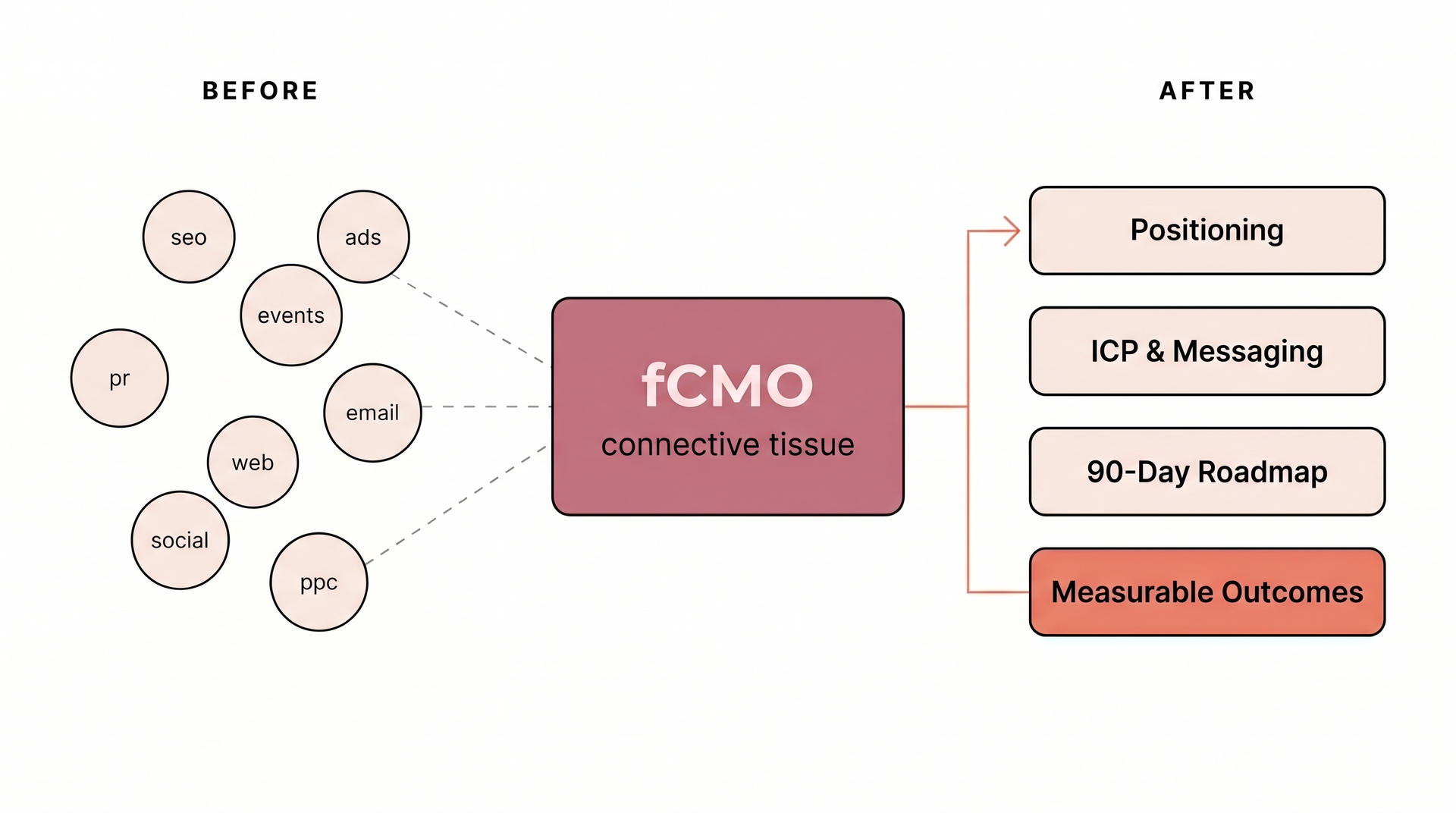
Here’s the off ramp: once that architecture exists, the CEO stops being the Chief Marketing Officer by default. You get to think about the next product line instead of approving banner ads.
Predictable Growth: Move from heroics to an engine
Most $5–20M companies are running on sales heroics. One or two reps who carry the number through sheer force of personality. When they have a good month, you have a good month.
When they’re sick, pipeline collapses.
A fCMO replaces heroics with an engine. That means a documented funnel with conversion rates at every stage. It means demand generation that produces Marketing Qualified Leads on a predictable cadence, not a feast or famine cycle. It means an attribution model, even if imperfect; so you stop arguing about which channel “really” works.
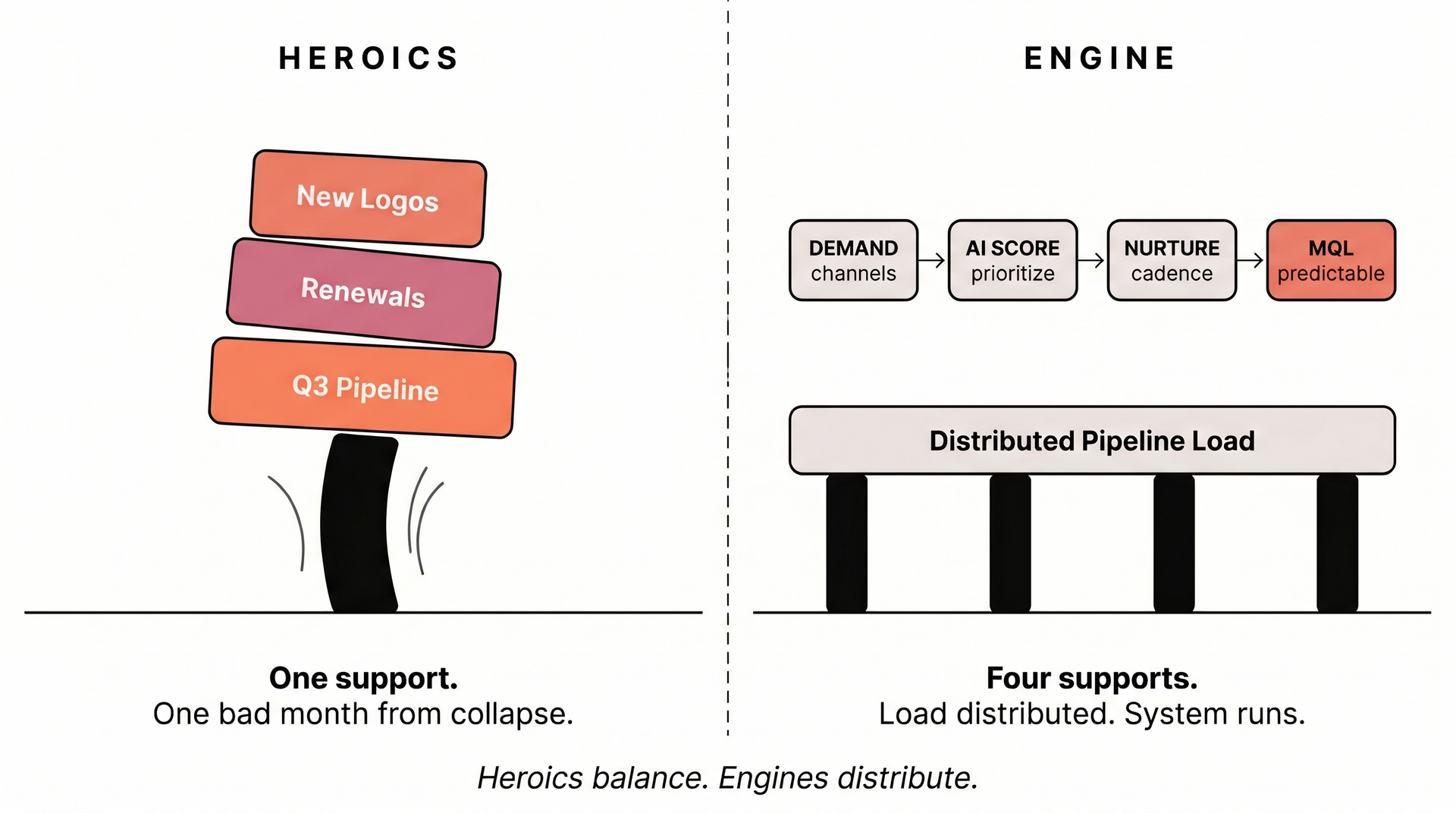
In 2026, this engine is fundamentally AI enhanced. Not because AI is fashionable, but because the math has changed. Your competitors are using predictive scoring to prioritize accounts in real time. They’re running multivariate experiments at a speed that was impossible 24 months ago. If your pipeline still depends on a rep manually working a list from a trade show, you are not in the same race.
Strategic Orchestration: Escape the MarTech graveyard
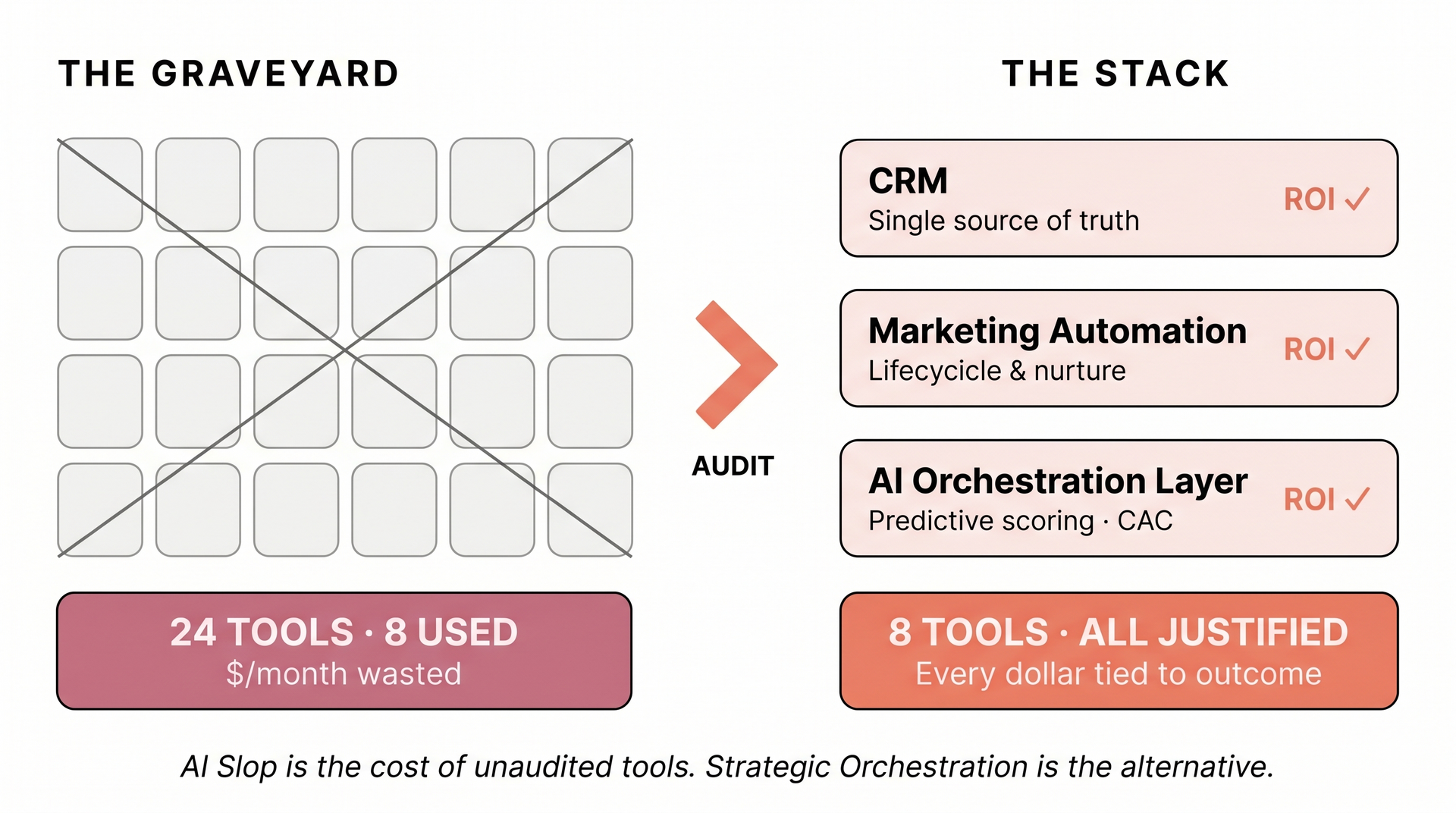
Open your billing statements. Count the SaaS tools your marketing team is paying for. The average company in your revenue band has between 18 and 30 marketing tools, and uses maybe a third of them meaningfully. This is the MarTech Graveyard: shelfware accumulated through three different marketing leaders, each of whom believed their previous stack would solve the problem. It didn’t. The tools weren’t the problem.
An fCMO audits this brutally. Every tool gets a job description and an ROI number. The ones that can’t justify themselves get cut. The ones that stay get integrated into a single source of truth, because data sitting in seven disconnected systems is not useful.The fCMO doesn’t “add AI tools.” They build the data infrastructure that makes AI useful.
This is also where AI Debt shows up. You’ve accumulated AI Debt every time someone on your team plugged a generative tool into a workflow without thinking about data infrastructure, brand voice, or measurement. You don’t see it on the balance sheet, but you feel it: inconsistent output, brand drift, a content library that’s growing in volume but declining in conversion rate.
The new mental model: At $10M ARR, you are not competing on product features. You are competing on mathematical efficiency. Whoever has the cleanest data and the best AI orchestration will win the CAC war.
This is the difference between AI Slop and Strategic AI Orchestration. AI Slop is what happens when a junior team uses ChatGPT to write 40 blog posts a month. It’s generic, it’s everywhere, and Google has stopped rewarding it. Strategic AI Orchestration is when an fCMO designs a system where AI predicts churn from product usage signals, optimizes ad spend across channels in near real-time, personalizes lifecycle emails based on behavioral cohorts, and frees your humans to do the work that actually requires judgment.
Team Empowerment: Compound ROI by improving, not replacing
You don’t need to fire your existing marketing team. You need to upgrade what they’re capable of.
A good fCMO is a player coach. They sit with your team and teach them how to think strategically, not just execute briefs. They run weekly working sessions where the team learns to interpret data, defend trade offs, and ship with a higher bar. Within 12 months, your coordinator is operating at the level of a senior marketer; because they’ve been mentored, not just managed.
This is where the ROI compounds. The fCMO eventually transitions their responsibilities or takes on formal leadership. The capability they installed stays.
The Economics: Risk vs. reward
Compare honestly:
- A full-time CMO costs $280–400K in total comp, takes 4–6 months to hire, takes another 3 months to ramp, and has roughly a 50/50 chance of being the wrong hire. Total exposure: north of half a million dollars and a year of momentum.
- A Fractional CMO costs $10–15K per month, starts in two weeks, and is operational on day one. If they’re not working, you replace them in 30 days with no severance and no drama.
The math isn’t subtle.
Close the scale up gap and free yourself to lead
You did not start this company to approve marketing campaigns. You started it because you saw something the market didn’t. That’s the work only you can do.
The Fractional CMO is not a luxury hire. In 2026, with AI rewriting what efficient growth looks like quarter by quarter, it’s the structural unlock that lets a $5M company become a $20M company without burning out the founder or burying the team in tool subscriptions.
Hire the architect. Get the system. Get back to the work that actually built this company.
About the author
Jon Louis is a marketing leader who has built brands and top performing teams across technology, healthcare, and professional services organizations.